
Personal
Car Stuff
Extras

S2 Elise & M250 in Munich
For pictures of the stunning M250, and the launch of the Elise S2,click on the thumbnails below
) |
) |
) |
) |
More images of the M250 and the pre-production Elise S2 here, full sized pictures here
Official Lotus Club M250 article here
Official German M250 brochure here
S2 info from the 2000 Birmingham motorshow here
Unfortunately the S2 went into production :( , but the M250 didn't :((
From an ex-Lotus employee: Lotus had every intention of putting M250 into production. There were 120 people working on the project, which for Lotus was a huge team. The production styling was very close to the show car - including the interior. The "unbranded V6 motor" was a real engine with a real contract in place, not Renault though. Engines were fitted to the three running mules when the project was folded. There was even a project to Federalise the vehicle with a launch 12 to 18 months after the European launch, but Lotus ran out of money putting the VX200 and the S2 into production, robbing M250 of the capital to start spending serious development funds. The chassis was not a stretched Elise chassis and it did not share any components with it, other than the glue.
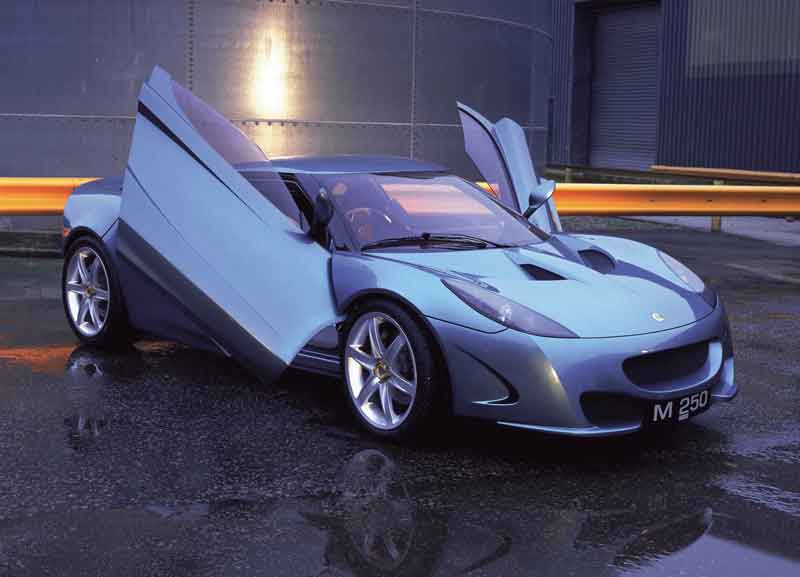
Frankfurt Motorshow 1999 - Lotus M250
THE M250 CONCEPT CAR -THE START OF SOMETHING SPECIAL
Today at the 58th Internationale Automobil-Ausstellung (I.A.A.) in Frankfurt, Lotus presents the Project M250 Concept Car - the latest sportscar development from Lotus.
This two-seater, mid-engined, high performance supercar possesses world leading aerodynamic downforce combined with unrivalled chassis stiffness to give a unique driving experience. By being exceptionally lightweight, the M250 Concept Car achieves sensational performance: a true Lotus.
Powered by a mid-mounted Lotus-developed 3.0 litre V6 engine that drives the rear wheels through a six-speed gearbox, the M250 would, if it was to be built, slot into the Lotus line-up between the Elise and the Esprit.
Instead of aiming for ultimate top speed, Lotus has placed the emphasis on driving pleasure in the M250. That said, it will be brutally fast in everyday driving conditions -0-100km/h (0-62mph) in less than 5.0 seconds, 0-160 km/h (0-100 mph) in less than 11.0 seconds. Top speed will be electronically limited to
250km/h (155mph), a move which gives Lotus engineers tremendous freedom to optimise the rest of the car's dynamic qualities and give it impressive high-speed stability and superb handling.
As it's a Lotus, the M250 is a light car and its unladen weight will be less than 1000kg -which brings tremendous benefits in terms of driveability and response to the throttle and steering wheel. Its power-to-weight ratio will embarrass many rivals, as will its agility and its levels of driver satisfaction.
Even though the M250 will be equipped with all the standard luxury items you expect in a car in this price bracket, it isn't lumbered with the intrusive electronic driver intervention devices that are taking the fun out of many other sports cars. Although intended as more of an everyday car than the Elise, the M250 remains a true instrument for driving.
The Styling -Attitude and Agility
The concept car on display at the I.A.A. is fresh from the Lotus Engineering's Styling Department's modelling division, based at Lotus-Coventry, England. The M250 shows the design philosophies for Lotus cars of the future: a cabin-forward design and short overhangs, front and rear to create a mean, purposeful look.
Russell Carr, Head of Styling and Design at Lotus, explains: "The M250 blends sensuous lines with contemporary, crisp design elements, to give it what we like to refer to as 'attitude'.
"Although it's a ground-up design, we've chosen to give the M250 visual bond with the Elise and the 340R - you can see the links in the top-exiting front radiators, the distinctive side air vents, and in the general proportions of the car; it's compact, agile and athletic.
"But the M250's overall look is very much its own and we're extremely proud of the design, particularly the wrap-around windscreen, which is very similar to a visor on a motorbike helmet."
A major achievement in the M250's design is that it has excellent aerodynamic properties 'straight out of the box'. Lotus engineers and designers have used the knowledge learned from designing competition cars to create a shape with an extremely well balanced aerodynamic package. Downforce and high speed stability were given priority over a very low drag coefficient in the design of the M250, and to manage the airflow underneath the car to conjure up even greater downforce resulting in a Cz of 0.15.
Lightweight - As Expected from Lotus
The M250 wouldn't be a proper Lotus unless lightweight was an important part of its genetic make-up; it's an integral part of Lotus Car's whole philosophy. The concept's chassis improves and develops upon the bonded extruded aluminium technology used to such great effect in the Elise.
Lotus engineers are continually investigating new construction techniques and technology as well as new materials, though such advances will only be introduced when proven to offer a genuine advantage - it isn't the Lotus way to use things just because they look pretty or are fashionable.
There are several innovative options regarding what materials the body should be made from. All possibilities are being explored including aluminium/composite construction. In addition to being lightweight, the body material will support high quality manufacturing techniques.
Lower the weight and you can reduce the power
Rather than enter the horsepower race, Lotus has opted to follow the more rewarding "power-to-weight" path. Target unladen weight for the M250 is less than 1000kg, and the expected power output from the Lotus-developed 3.0-litre V6 is 186kW (250bhp).
Electronically limited to 250 km/h (155mph), the M250 flexes its muscles at the lower, and more often used, end of the performance spectrum - standstill to 100km/h (0-62mph) will be achieved in less than 5.0 seconds, while its sub-11.0 seconds 0-160 km/h (0-100 mph) time takes it firmly into supercar territory.
"If we decide to build the M250, it will be the best handling car ever from Lotus," according to Lotus Cars' Managing Director, Graham Peel, "Throttle response will be superb and the car will feel agile and truly special to drive. It will sound great, have a first-rate gear change and excellent ABS-assisted brakes.
"The concept behind the M250 is to produce another superlative driver's car, in the same mould as the Elise, but with technical refinements and enhancements made possible through what we've learned from over 50 years of sportscar development."
However, the M250 will be more of an everyday car than the Elise. It will have 'creature comforts' such as air-conditioning, central locking and electric windows. But there won't be any unnecessary electronically controlled stability aids or traction control devices - Lotus prefers to produce a responsive and well-behaved chassis in the first place.
If the car were to go into production and become the next new Lotus then it would be in European dealers in the first half of 2001, built in similar volumes to the Elise (currently over 3000 cars a year).
Technical Specification
Engine: Transverse mid-mounted naturally aspirated 3.0 litre
V6
Double overhead camshafts
Electronic fuel injection
Electronic engine management system
Maximum Power: 186 kW (250 bhp)
Transmission: Manual 6-speed transverse mounted gearbox driving
rear wheels through a hydraulic clutch
Body: Aluminium/composite construction, 2 seater coupe
Aerodynamic force Cz of 0.15
Chassis: Bonded Aluminium/composite tub with modular chassis
construction for higher stiffness
1st torsional mode > 60Hz
Suspension: Independent upper and lower wishbones Co-axial
springs and dampers
Steering: Rack and pinion (power assisted)
Wheels: 6 spoke aluminium alloy
Front: 8J x 18
Rear: 10J x 19
Tyres:
Front: 225/40 ZR18
Rear: 285/35 ZR19
Brakes: 320mm-diameter cast iron ventilated discs
4 piston racing callipers all round ABS
Weight: less than 1000kg
Dimensions:
Wheelbase: 2518mm
Length: 4137mm
Width: 1817mm
Height: 1166mm
Performance:
Acceleration: 0-100km/h (0-62mph) - less than 5.0 seconds
0-160 km/h (0-100mph) - less than 11.0 seconds
Top speed: 250km/h (155mph) - Electronically limited

