
Personal
Car Stuff
Extras

www.lotuscars.co.uk
|
 Lotus
Elise
Lotus
Elise |
 |
 |
Keeping up appearances
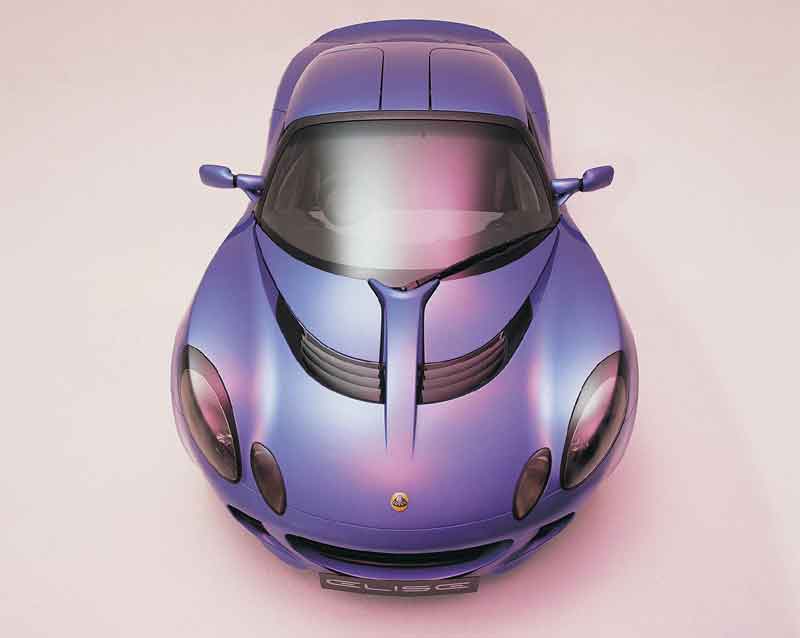
Style is an Elise trademark. The Elise look is instantly recognisable. When design work started there was universal agreement within Lotus that its looks should be an evolution of the existing form. But looks are not the only ground breaking feature of the Elise design.
The Elise will make its mark in history as the first Lotus created on computer. This advanced digital process translates concept form to full size reality in a fraction of the time, dramatically reducing styling and tooling design effort and allowed the project to be completed in under one year.
As with so many Lotus models,
the design brief for the Elise was to produce a shape both modern
and timeless, and as ever, the principles of form following function
were rigorously applied as the Lotus Design Team crafted the detail
into the final design.
But whereas the previous Elise
combines subtle curves and rounded shapes, the Elise now has sharper,
more aggressive edges. It sits closer to the ground (by 10mm), its
wheel and tyres more fully fill the wheelarches and its rear haunches
are more pronounced. Head-on it has a meaner, more menacing look,
and from every angle it portrays speed, motion and energy. As every
Lotus should.
The Principal Designer in charge of the Elise design, Steve Crijns, explains some of the changes. "We wanted to create a shape that would reflect an incredible driving experience. The car has to look a hell of a lot more exciting than your everyday 2 seater cabrio. But we also wanted to be honest and not have any features just for stylistic effect. We started the design by shrink wrapping the bodywork around the mechanical components. Unnecessary bulk, even if it's for stylistic effect, creates weight, and a Lotus must be light. Very early in the design phase the full size clay model went to the wind tunnel where the rear spoiler and rear diffuser were created to optimise downforce without causing drag."
As with everything on a Lotus, the diffuser is not just a cosmetic enhancement, the Elise aerodynamics were developed to balance downforce over both the front and rear axles. This aids high-speed stability and has been achieved without increasing drag in soft or open top configurations. In fact, the lowered roofline and new hard top actually reduce the drag figures.
Crijns goes on to add, "We wanted to emphasise that the Elise is rear wheel drive by increasing the power and volume of the bodywork over the rear wheels. Lowering the bonnet and reducing the waistline accentuates the width at the rear. Also, having larger diameter wheels at the rear than those at the front helps with this effect. In total, the design details of the Elise pay homage to the very best elements of classic sportscars. Add the design cues from the motorsport world, such as the fuel filler cap and the bold treatment of the rear diffuser, and the result speaks for itself."
Recent Lotus designs have also helped shape the Elise. Its sealed unit headlamp pack has a strong family link to the exclusive 340R, while the quartet of multi-function round rear lamps echo those of Project M250.
The rear tail section of the Elise is slightly longer than that of the previous car, this increased length and use of the full width of the rear bodywork creates a much increased luggage space area.
The revised hood design still flows aft over the rear roll-over bar and onto the Elise's tapered rear buttresses. The soft-top has been redesigned to simplify assembly so it's much easier to remove and store in the boot. The new hard-top has a novel design. 'Gullwing' roof panels, which can be easily opened to improve access to the cockpit, and removed, and stored in the boot, to turn the Elise into a targa-top for those days when the sun looks friendly but the air temperature isn't.
Every body panel on the Elise is new and they are now made using polished high grade steel tools by French specialist, Sotira. This provides world class composite panels of a superior quality level over the traditional hand-laid glassfibre process, it also allows them to be thinner and lighter. This helps to explain why the Elise, despite its increased length and additional specifications, weighs in at just 710kg.

